Key Takeaways
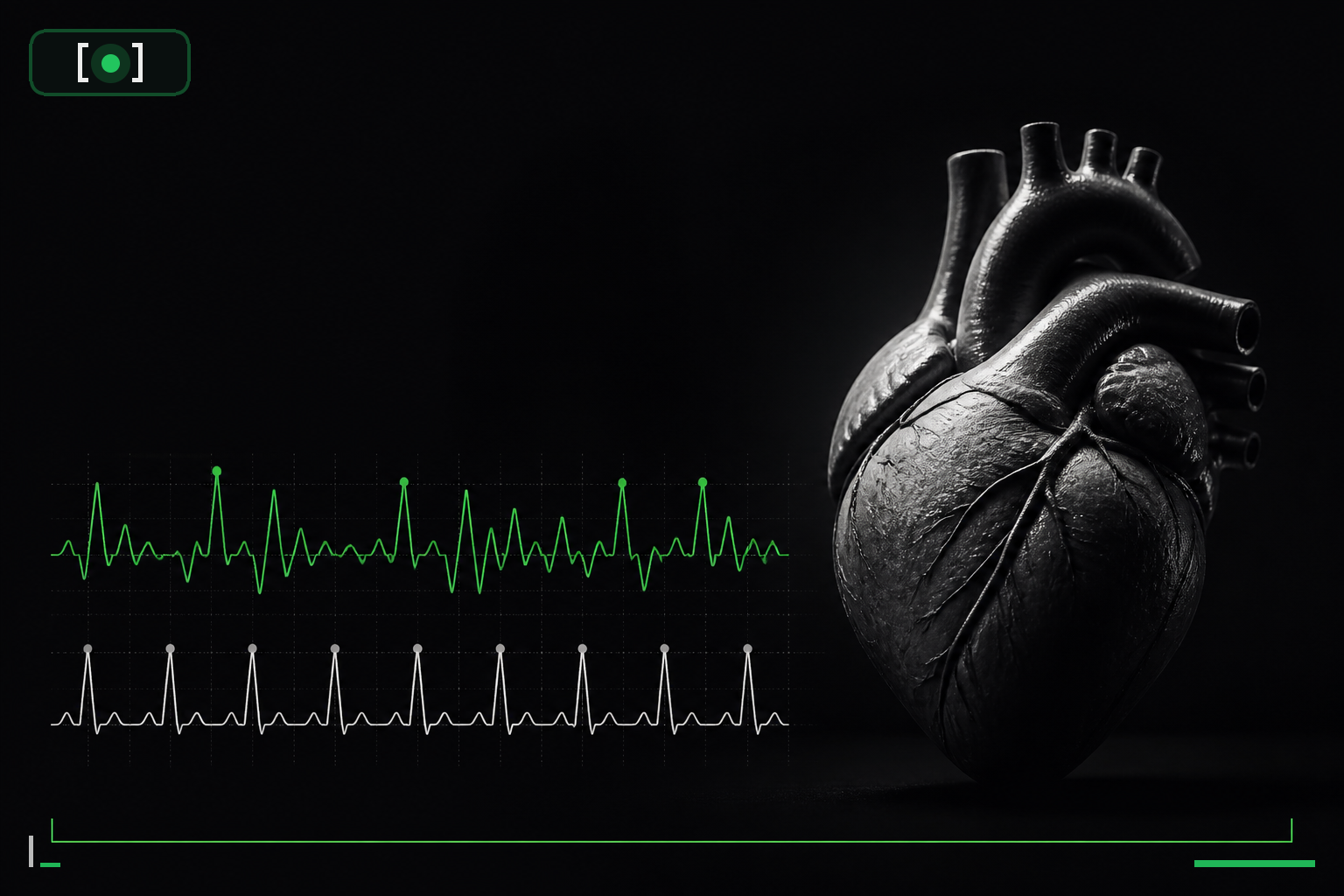
- Heart rate variability (HRV) measures the beat-to-beat variation in heart rhythm, serving as a non-invasive proxy for autonomic nervous system (ANS) balance.
- A higher HRV generally indicates parasympathetic dominance and a readiness to handle stress, while a suppressed HRV suggests sympathetic overdrive or systemic fatigue.
- RMSSD (Root Mean Square of Successive Differences) is the most reliable short-term metric for assessing recovery capacity in consumer wearables.
- Absolute HRV numbers are highly individual; the most actionable data comes from tracking your 7-day rolling average against your long-term baseline.
- Acute drops in HRV are often associated with poor sleep, alcohol consumption, high-intensity training, or the onset of illness.
The autonomic tug-of-war
Heart rate variability is the variation, in milliseconds, between successive heartbeats. A resting heart beating at 60 beats per minute does not beat exactly once per second — the intervals fluctuate. That fluctuation is driven by the autonomic nervous system's continuous modulation of the sinoatrial node.
This system operates as a balance between two branches. The sympathetic nervous system (SNS) acts as the "accelerator," preparing the body for action by increasing heart rate and decreasing variability. The parasympathetic nervous system (PNS), largely via the vagus nerve, acts as the "brake," slowing the heart rate and increasing the complexity of the rhythm.
In a well-recovered state at rest, parasympathetic tone dominates and HRV is relatively high. This indicates a nervous system that is flexible and capable of responding to new demands. When the system is overloaded by training, psychological stress, or metabolic triggers like Insulin Sensitivity issues, the SNS takes over, and the heart rhythm becomes more metronomic and less variable.
Why absolute numbers are misleading
One of the most common mistakes in the recovery community is comparing absolute HRV values between individuals. A 25-year-old elite athlete might have a baseline RMSSD of 100ms, while a healthy 45-year-old might sit at 40ms. This does not necessarily mean the athlete is "more recovered" in a relative sense; it reflects differences in age, genetics, and heart morphology.
HRV is a highly personalized metric. Research published in Frontiers in Physiology suggests that genetic factors may account for up to 30% of the variance in HRV. Therefore, the goal of tracking is not to reach a specific number, but to monitor deviations from your own established baseline. A "high" number for you might be a "low" number for someone else.
The metrics that matter
While there are dozens of ways to calculate variability, the industry has largely converged on a few specific time-domain and frequency-domain measurements.
| Metric | Definition | Primary Use Case |
|---|---|---|
| RMSSD | Root mean square of successive differences | Assessing acute recovery and parasympathetic tone |
| SDNN | Standard deviation of NN intervals | Long-term health tracking and overall ANS resilience |
| LF/HF Ratio | Ratio of Low to High Frequency power | Historically used to measure "balance," though now debated |
| CV of RMSSD | Coefficient of variation in RMSSD | Measuring how much your recovery fluctuates day-to-day |
RMSSD is favored in sports science because it is less sensitive to breathing rate than other metrics and can be captured accurately in short windows (e.g., 1–3 minutes). Most consumer wearables use this as their primary input for "readiness" scores.
Factors that suppress the signal
HRV is a sensitive but non-specific biomarker. It tells you that the system is under stress, but it does not tell you why. To use the data effectively, you must correlate drops in HRV with behavioral inputs.
Common suppressors include: - Sleep deprivation: Even a single night of restricted sleep can significantly lower morning HRV by disrupting Sleep Architecture. - Alcohol consumption: Ethanol is a potent sympathetic stimulant; even one or two drinks can suppress HRV for 24–48 hours. - Training load: High-intensity sessions create a temporary dip in HRV as the body works to repair tissue and restore homeostasis. If HRV remains low for several days, it suggests the Hypertrophy Equation is skewed toward overreaching. - Psychological stress: The brain does not distinguish perfectly between a hard squat session and a high-stakes work deadline; both trigger the same autonomic response.
The role of the vagus nerve
The vagus nerve is the primary conduit for the parasympathetic signal. Improving "vagal tone" is often cited as a way to raise baseline HRV. While some interventions like cold exposure or deep breathing have acute effects, long-term improvements in HRV are most consistently linked to aerobic fitness. A larger, more efficient heart requires less sympathetic input to maintain cardiac output, allowing the parasympathetic system to exert more influence at rest.
How to establish a reliable baseline
Because HRV is so sensitive, a single measurement is virtually useless. To find your true baseline, you need at least 7 to 14 days of consistent data. Most experts recommend taking the measurement at the same time every day—either automatically during sleep (as wearables do) or immediately upon waking.
Once a baseline is established, you can look for trends. A 7-day rolling average that is trending upward often indicates an increase in aerobic fitness or a successful reduction in systemic stress. Conversely, a downward trend—even if you feel "fine"—is often a leading indicator of impending illness or overtraining.
Using HRV to guide training is known as "HRV-guided programming." A 2020 meta-analysis found that athletes who adjusted their training intensity based on their daily HRV achieved similar or better performance gains with lower total volume compared to those following a fixed plan.
The nuance of high HRV
While high HRV is generally positive, more is not always better. In some cases, an unusually high HRV—well above your normal ceiling—can be a sign of "parasympathetic overreaching." This occurs when the body is so exhausted that the nervous system essentially forces a shutdown state. This is often accompanied by a very low resting heart rate and a feeling of lethargy. This is why interpreting the data requires context; a record-high HRV on a day you feel exhausted is not a green light to train hard.
The bottom line on autonomic tracking
HRV is a window into the state of your internal environment. It provides a quantitative check on the qualitative feeling of being "burned out" or "ready to go." However, it is a tool for refinement, not a master to be obeyed blindly. If your HRV is low but you feel excellent, it may be a day to monitor closely rather than cancel your session.
Used correctly, HRV helps you identify the hidden stressors in your life—whether that is a late-night meal, a lack of Sleep Architecture quality, or chronic work stress—and allows you to adjust your recovery protocols before a minor dip becomes a significant burnout. The data is most powerful when it confirms what your body is already trying to tell you.
Get the Weekly Research Dispatch
One email each week featuring evidence-based health research, longevity insights, and performance science.

Zone 2 Training and Mitochondrial Density: The Science of Metabolic Efficiency
Zone 2 training is often dismissed as 'junk miles,' yet it is the primary driver of mitochondrial biogenesis and metabolic flexibility. Here is how the physiology actually works.
Heart Rate Variability: The Physiology of the Autonomic Stress Signal
HRV is a non-invasive window into the autonomic nervous system. Learn how to interpret the fluctuations between heartbeats to optimize training and manage systemic stress.
Heart Rate Variability: What It Measures and What It Misses
HRV is one of the most useful — and most misinterpreted — recovery metrics available. Here is a comprehensive look at what it measures, what it does not, and how to actually use it.