Key Takeaways
- Heart rate variability (HRV) measures the beat-to-beat variation in heart rhythm, serving as a non-invasive proxy for autonomic nervous system (ANS) balance.
- A higher HRV generally indicates parasympathetic dominance and a readiness to handle stress, while a suppressed HRV suggests sympathetic overdrive or systemic fatigue.
- RMSSD (Root Mean Square of Successive Differences) is the most reliable short-term metric for assessing recovery capacity in consumer wearables.
- Absolute HRV numbers are highly individual; the most actionable data comes from tracking your 7-day rolling average against your long-term baseline.
- Acute drops in HRV are often associated with poor sleep, alcohol consumption, high-intensity training, or the onset of illness.
The autonomic tug-of-war
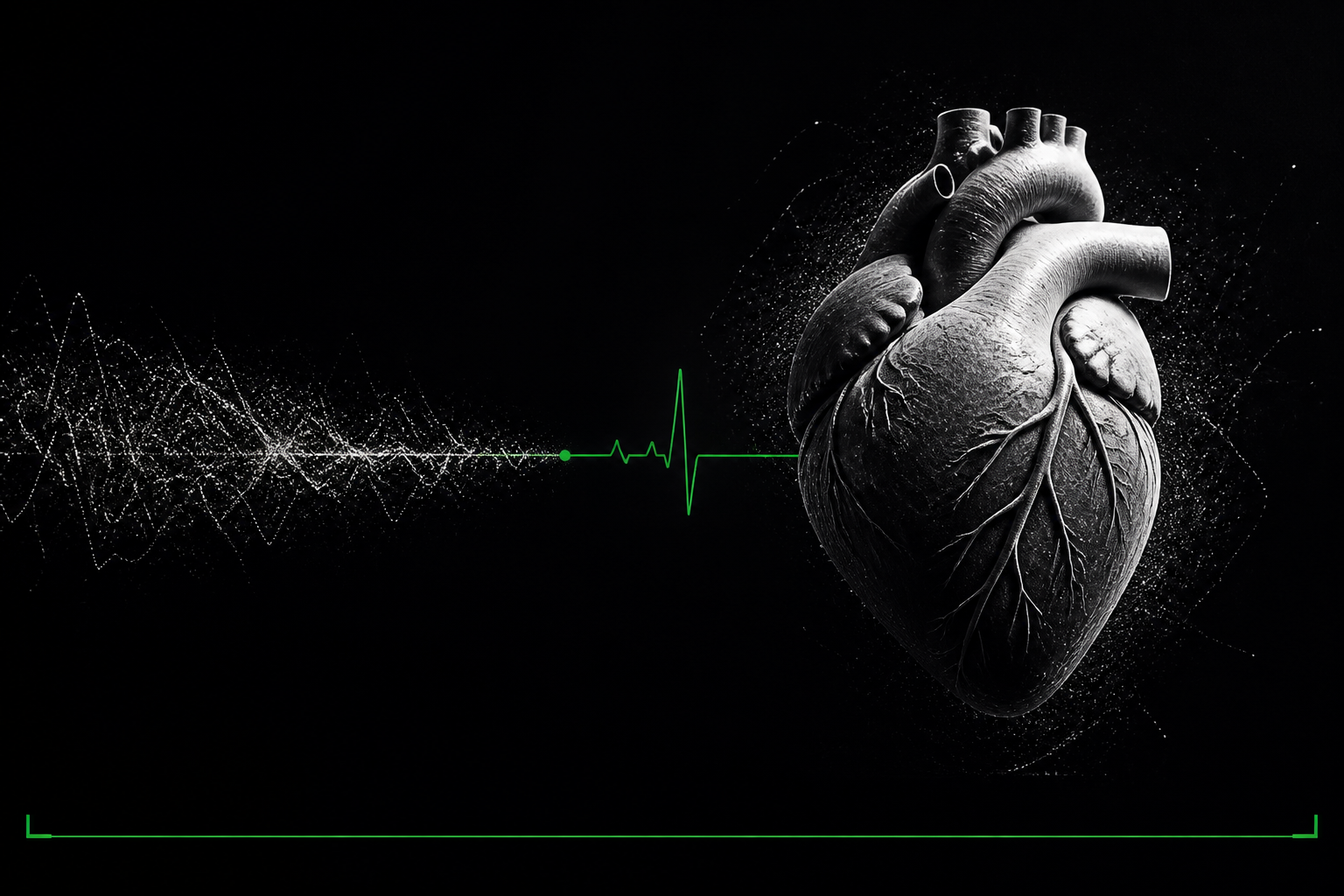
Heart rate variability is the variation, in milliseconds, between successive heartbeats. A resting heart beating at 60 beats per minute does not beat exactly once per second — the intervals fluctuate. That fluctuation is driven by the autonomic nervous system's continuous modulation of the sinoatrial node.
This system operates as a balance between two branches. The sympathetic nervous system (SNS) acts as the "accelerator," preparing the body for action by increasing heart rate and decreasing variability. The parasympathetic nervous system (PNS), largely via the vagus nerve, acts as the "brake," slowing the heart rate and increasing the complexity of the rhythm.
In a well-recovered state at rest, parasympathetic tone dominates and HRV is relatively high. This indicates a nervous system that is flexible and capable of responding to new demands. When the system is overloaded by training, psychological stress, or metabolic triggers like Insulin Sensitivity and the Pre-Diabetic Window Most People Miss issues, the SNS takes over, and the heart rhythm becomes more metronomic and less variable.
Why absolute numbers are misleading
One of the most common mistakes in the recovery community is comparing absolute HRV values between individuals. A 25-year-old elite athlete might have a baseline RMSSD of 100ms, while a healthy 45-year-old may sit at 40ms. Neither number is inherently "better" in a vacuum; HRV naturally declines with age and is heavily influenced by genetics and left ventricular morphology.
The value of HRV lies in its deviation from your specific baseline. A person with a baseline of 80ms who wakes up with a 50ms reading is likely in a state of significant systemic strain, even though 50ms might be a "peak" recovery score for someone else. This is why most research focuses on the 7-day rolling average, which smooths out the "noise" of a single bad night's sleep to show the true direction of your recovery trend.
The metrics that matter: RMSSD vs. SDNN
When you look at your wearable data, you are likely seeing one of two primary time-domain metrics. While both track variability, they represent slightly different physiological windows.
| Metric | Physiological Focus | Practical Use Case |
|---|---|---|
| RMSSD | Parasympathetic (Vagal) Tone | The gold standard for daily recovery and training readiness. |
| SDNN | Total Autonomic Activity | Better for 24-hour recordings; reflects long-term health and circadian rhythm. |
| HF (High Frequency) | Respiratory Sinus Arrhythmia | A frequency-domain metric that maps closely to vagal activity. |
| LF/HF Ratio | Autonomic Balance | Historically used to show SNS/PNS balance, though its accuracy is debated in recent literature. |
Most modern research suggests that RMSSD is the most robust metric for short-term measurements (like a 2-minute morning reading). It is less affected by breathing rates than other metrics, making it a reliable signal for how much "gas" you have in the tank for the day's training session.
Stressors that move the needle
HRV is a sensitive but non-specific biomarker. It tells you that the body is under stress, but it doesn't necessarily tell you why. Because the autonomic nervous system processes all stress—whether physical, emotional, or chemical—in the same "bucket," various factors can trigger a drop in variability.
The impact of sleep and alcohol
Perhaps the most reliable way to tank HRV is through alcohol consumption. A 2020 study published in JMIR Mental Health found that even low alcohol intake reduced HRV by an average of 9.3%, while high intake suppressed it by nearly 40%. This occurs because alcohol increases sympathetic activity and disrupts Sleep Architecture and Metabolic Health: The Deep Sleep-Insulin Connection, preventing the parasympathetic nervous system from performing its nightly "reset."
Training load and overreaching
In the context of exercise, HRV is a leading indicator of functional overreaching. While a hard session will cause an acute drop in HRV for 24–48 hours, a chronic downward trend despite rest days suggests that the volume or intensity is exceeding the body's adaptive capacity. Conversely, a steady increase in baseline HRV over months is often a sign of improved cardiovascular efficiency, often seen after a dedicated block of Zone 2 Training and Mitochondrial Density: The Science of Metabolic Efficiency.
Interpreting the "Parasympathetic Trap"
While high HRV is usually good, there is a phenomenon known as "parasympathetic overreaching." In cases of extreme fatigue, the body may enter a state of hyper-recovery where the heart rate becomes abnormally low and HRV becomes unusually high. This isn't a sign of being super-fit; it’s a sign that the sympathetic nervous system is so exhausted it can no longer mount a response.
If you see a massive spike in HRV accompanied by a feeling of profound lethargy and a low resting heart rate, it may be a signal to take an unplanned deload. This highlights why HRV should never be used in isolation. It must be paired with subjective data—how you feel, your muscle soreness, and your motivation to train.
How to establish a clean baseline
To get actionable data, consistency in measurement is non-negotiable. The autonomic nervous system is highly reactive; even standing up or checking an email can shift your numbers.
- Time of day: Measure immediately upon waking or use a wearable that tracks exclusively during deep sleep.
- Position: If measuring manually, stay in the same position (seated or lying down) every day.
- Context: Note external factors. A low HRV after a night of poor sleep is expected; a low HRV after 9 hours of sleep is a much louder signal that something, like an impending illness, is taxing the system.
By following these protocols, you can begin to see how your physiology responds to the variables you control. You might find that Dopamine Regulation and the Mechanics of Sustained Motivation practices, such as morning sunlight or cold exposure, have a measurable impact on your autonomic resilience over time.
The honest summary of HRV tracking
Heart rate variability is not a crystal ball, but it is the most accessible tool we have for monitoring the invisible work of the autonomic nervous system. It bridges the gap between how we think we are recovering and how our physiology is actually responding to the total load of our lives.
Rather than obsessing over the daily fluctuations, use HRV to identify patterns. If your 7-day average is trending up, your current training and recovery protocols are likely working. If it is trending down, the body is asking for a change—whether that means more sleep, better nutrition, or a reduction in training volume. It is a dashboard light for the human body; ignore it at your own peril, but use it wisely to stay in the fight longer.
Get the Weekly Research Dispatch
One email each week featuring evidence-based health research, longevity insights, and performance science.

Zone 2 Training and Mitochondrial Density: The Science of Metabolic Efficiency
Zone 2 training is often dismissed as 'junk miles,' yet it is the primary driver of mitochondrial biogenesis and metabolic flexibility. Here is how the physiology actually works.
Heart Rate Variability: What It Measures and What It Misses
HRV is one of the most useful — and most misinterpreted — recovery metrics available. Here is a comprehensive look at what it measures, what it does not, and how to actually use it.
Heart Rate Variability: The Physiology of the Autonomic Stress Signal
HRV is one of the most useful — and most misinterpreted — recovery metrics available. Here is a comprehensive look at what it measures, what it does not, and how to actually use it.