Key Takeaways
- Anderson Silva and Conor McGregor sustained documented tibia and fibula fractures in UFC competition. Their surgical histories are separate from research on experimental peptides; this article does not suggest either athlete used them.
- Bone union, return to training, and readiness for competition are different milestones. Early rehabilitation reports cannot establish that a fracture has fully healed.
- BPC-157 has been studied in animal bone-injury models, but those findings do not establish faster fracture healing in humans.
- TB-500 is not interchangeable with full-length thymosin beta-4. Evidence for one molecule cannot simply be transferred to another.
- “Wolverine Stack” is an informal name, not an established fracture-rehabilitation intervention. Regulatory discussion and anti-doping restrictions must not be confused with evidence of benefit.
Two broken legs, two documented medical histories
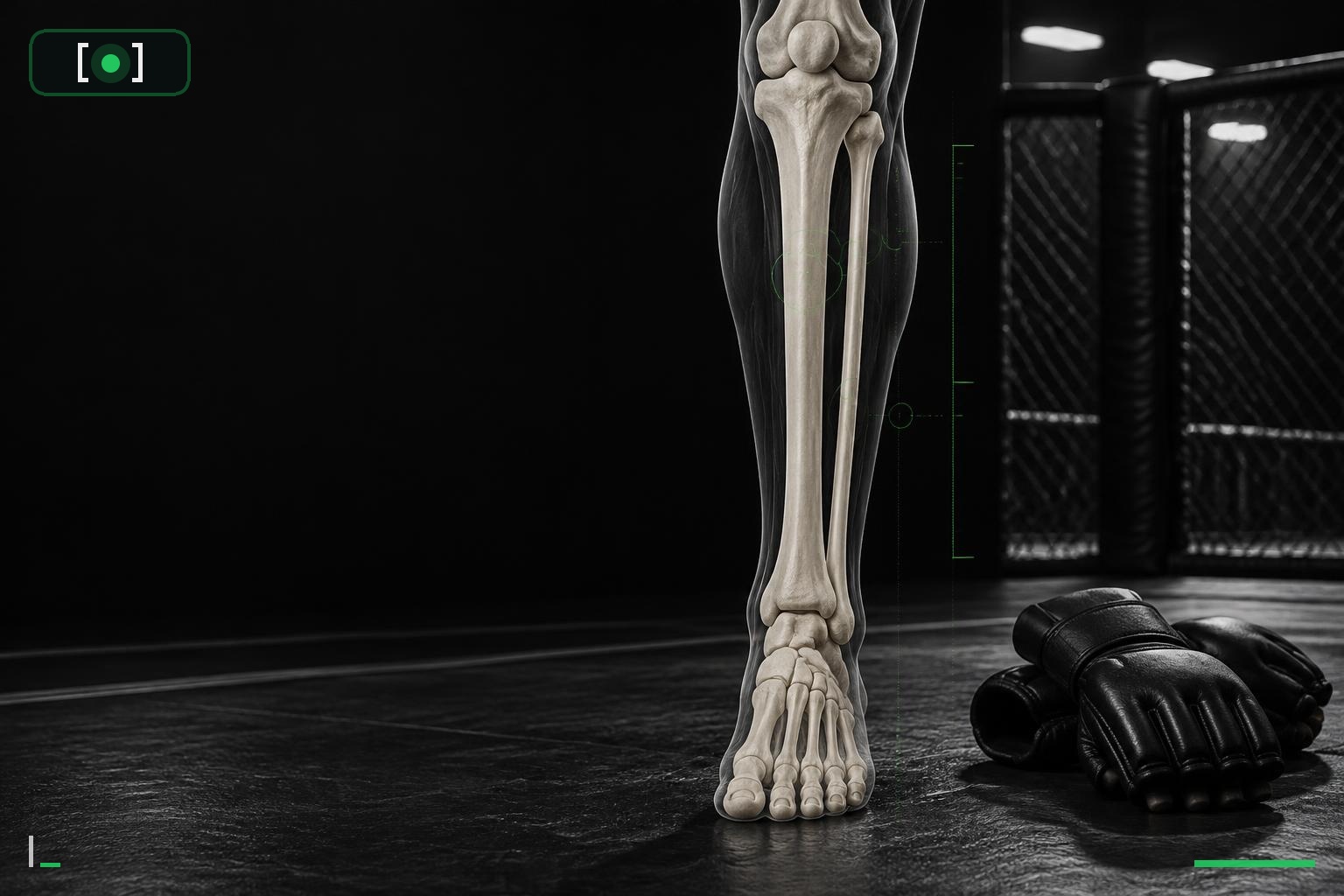
A checked kick can turn a championship fight into a medical emergency in an instant. When Anderson Silva faced Chris Weidman at UFC 168 on December 28, 2013, the injury to Silva's left leg became one of MMA's most widely remembered moments. What followed was orthopedic surgery—not a publicly documented peptide intervention.
The UFC's December 29 injury update reported that surgeon Steven Sanders repaired Silva's broken tibia with an intramedullary rod. The fibula was stabilized without separate surgery. UFC gave an estimated recovery window of three to six months and explicitly noted that recovery times vary. That estimate was not a deadline for returning to elite competition.
UFC reported some training activity in February 2014, roughly six weeks after the injury. “Training” can describe very different activities. The report should not be read as proof of complete bone union or unrestricted kicking and sparring.
Conor McGregor fractured his left tibia and fibula against Dustin Poirier at UFC 264 on July 10, 2021. ESPN's contemporaneous report described a successful three-hour operation and McGregor's statement that he expected six weeks on crutches. Those were reported postoperative plans, not published evidence that he would be medically ready to fight six weeks later.
Neither history establishes peptide use. Public accounts also aren't complete clinical records: they cannot tell us every rehabilitation detail, imaging result, or reason behind a later training decision. The useful comparison is between documented care and the much less developed evidence behind peptide claims.
Why repairing a fracture is more than repairing a bone
The tibia carries much of the lower leg's load. After a substantial fracture, the clinical problem involves stability, blood supply, surrounding soft tissue, and the person's ability to move safely—not merely the appearance of a break on an image.
An intramedullary rod sits inside the tibia and helps stabilize the fracture. It doesn't replace the body's biological repair work. In broad terms, healing involves an early inflammatory response, new tissue formation, and subsequent remodeling. The relative contribution of callus formation depends on the fracture and fixation environment; not every surgically stabilized fracture follows an identical visual sequence.
A review of fracture-healing mechanisms describes the interplay between mechanical conditions and biological signaling. Those processes provide a framework for understanding research. They do not make every intervention affecting a laboratory signaling pathway a useful human therapy.
For an athlete, the next question extends beyond bone. Strength, joint movement, balance, conditioning, and tolerance of progressively demanding activity can all matter. Someone may feel substantially better while still lacking the capacity for repeated impact or unpredictable contact. The broader role of recovery is explored in our sleep architecture article, but general recovery habits are not substitutes for fracture-specific care.
Bone union and returning to the cage are different outcomes
A recovery timeline becomes misleading when it compresses several separate milestones into one number. Being allowed to move, beginning supervised exercise, and tolerating unrestricted competition answer different clinical questions.
| Milestone | What it can describe | What it does not establish |
|---|---|---|
| Successful surgery | The planned stabilization procedure was completed | Complete biological healing |
| Early rehabilitation | Selected activity within clinical restrictions | Unrestricted loading or contact |
| Bone union | Clinical and imaging evidence of healing | Full strength, conditioning, or sport readiness |
| Return to competition | Readiness for the demands of a particular sport | Proof that any single intervention caused recovery |
That distinction matters when interpreting Silva's training reports or McGregor's crutch estimate. A public milestone is a piece of the story, not a controlled experiment. Comparing two athletes' timelines cannot isolate a treatment effect because their fractures, surgery, rehabilitation, and competitive circumstances may differ.
Useful questions when reading a recovery claim include:
- Was the measured outcome bone union, pain, movement, or simply a return to some training?
- Was the claim based on a clinical assessment, an athlete's statement, or a promotional testimonial?
- Was there a comparison group, and were the injuries comparable?
Without those details, “faster recovery” is too vague to support a scientific conclusion.
What the Wolverine Stack name actually describes
“Wolverine Stack” generally refers to combining BPC-157 with a product sold as TB-500. The memorable name makes the combination sound coherent, but a label is not a standardized formulation, an approved indication, or evidence that the two substances work better together.
BPC-157 is a synthetic peptide investigated largely in preclinical research. Our BPC-157 recovery evidence guide provides broader background; the narrower question here is whether evidence supports severe human fracture recovery.
TB-500 requires particular care with terminology. WADA's research page on TB-500 metabolism identifies an acetylated fragment of thymosin beta-4. Full-length thymosin beta-4 and that fragment are not the same molecule. Commercial naming can also be inconsistent, making it essential to identify what a study actually examined.
A result involving full-length thymosin beta-4 cannot be relabeled as clinical evidence for a fragment, an ambiguously named product, or a BPC-157 combination. Evidence for either component individually would still not establish the benefit or safety of combining them.
What the bone research shows—and where it stops
A 1999 rabbit study by Šebečić and colleagues investigated BPC-157 in a segmental defect of the radius. This was a deliberately created bone-defect model, not a human tibia and fibula fracture during a fight. The study reported a preclinical healing signal in that specific setting.
The model is scientifically relevant to asking whether the peptide warrants further investigation. It does not answer whether the same effect occurs after human fracture fixation, whether an athlete returns to competition sooner, or what adverse effects might emerge with human exposure.
A 2025 systematic review in HSS Journal included 36 BPC-157 studies: 35 preclinical studies and one clinical study. Its literature search ended June 3, 2024, so those counts describe the included literature, not all research available in October 2026. The clinical study concerned knee pain, not controlled human fracture healing. A substantial animal literature can coexist with very limited human evidence.
| Evidence being discussed | Reasonable interpretation | Unsupported leap |
|---|---|---|
| BPC-157 in a rabbit radius defect | A hypothesis-generating preclinical finding | Proven benefit for human tibia/fibula fractures |
| Other animal tissue studies | Possible mechanisms worth investigating | Established athlete rehabilitation outcomes |
| Full-length thymosin beta-4 research | Evidence about the studied molecule and setting | Equivalent efficacy of TB-500 |
| The proposed combination | A separate question requiring direct study | Superior healing because two peptides are combined |
To establish a human fracture benefit, research would need appropriate comparison groups, defined injuries and treatment, meaningful healing outcomes, and systematic safety monitoring. Return-to-sport outcomes would require their own careful measurement. None of the evidence cited here establishes those benefits for the Wolverine Stack.
FDA oversight and anti-doping rules answer different questions
Compounding discussions are not drug approvals. FDA's 503A bulk-substance framework sets conditions for using bulk substances in compounding. Nomination, advisory review, and an approved fracture-healing indication are different regulatory concepts.
FDA listed BPC-157-related and TB-500-related substances for discussion at its July 23–24, 2026 Pharmacy Compounding Advisory Committee meeting. Advisory recommendations are nonbinding. FDA's official voting questions addressed free-base and acetate forms separately. An official OIRA review record records receipt on October 14, 2026 of an 'Interim Access Policy for Compounding Using Certain Peptides'; that record does not identify the substances or disclose a final policy. As of this October 20 review, a subsequent final BPC-157- or TB-500-specific determination has not been verified. That uncertainty must not be interpreted as either authorization or proof that no regulatory action occurred; none of these proceedings establishes a fracture-healing benefit.
Anti-doping rules apply independently. The 2026 WADA Prohibited List, effective January 1, 2026, expressly names BPC-157 under S0 (Non-approved substances, page 4) and thymosin beta-4 derivatives such as TB-500 under S2.3 (Growth factors and growth factor modulators, page 8). Both are prohibited at all times, in and out of competition. These entries were verified in a federation-hosted copy of the official 2026 list. Prohibition is not evidence of recovery efficacy.
UFC has its own program. The prohibited list currently linked from the official UFC Anti-Doping site is labeled effective January 1, 2024 and includes BPC-157 and thymosin beta-4 derivatives such as TB-500 as prohibited at all times. It should not be presented as a newly issued “2026 UFC list.” Athletes need the applicable current policy and commission requirements, rather than assuming an internet product label settles eligibility.
What these UFC injuries can honestly teach us
Silva's and McGregor's injuries illustrate the scale of the biological and sporting challenge after a severe fracture. Their documented surgeries and public rehabilitation milestones make that challenge concrete. They do not validate an experimental peptide combination.
The defensible answer is narrower than the marketing: BPC-157 bone findings are predominantly preclinical, TB-500 must be distinguished from full-length thymosin beta-4, and the cited evidence does not establish faster human fracture union or athletic return from their combination. Keeping those boundaries intact respects both the athletes' documented histories and the science still needed to answer the question.
Get the Weekly Research Dispatch
One email each week featuring evidence-based health research, longevity insights, and performance science.
BPC-157 Recovery Guide: What the Research Actually Supports
BPC-157 dominates the peptide recovery conversation, but most of the evidence is preclinical. Here is a calm, research-grounded look at what the studies really show — and what is being sold ahead of them.
TB-500 and Systemic Repair: What the Signaling Actually Does
Thymosin Beta-4 is one of the most abundant repair-signaling molecules in the body. Here is a comprehensive breakdown of the mechanism, the preclinical evidence, the translational gap, and where the synthetic TB-500 fragment fits.

BPC-157 and the Mechanism Behind Accelerated Tissue Repair
A deep, research-grounded look at how BPC-157 signals tissue repair — the angiogenic, growth-factor, nitric oxide, and gut-brain pathways, what the preclinical literature actually shows, where the human data stops, and how to think about it.